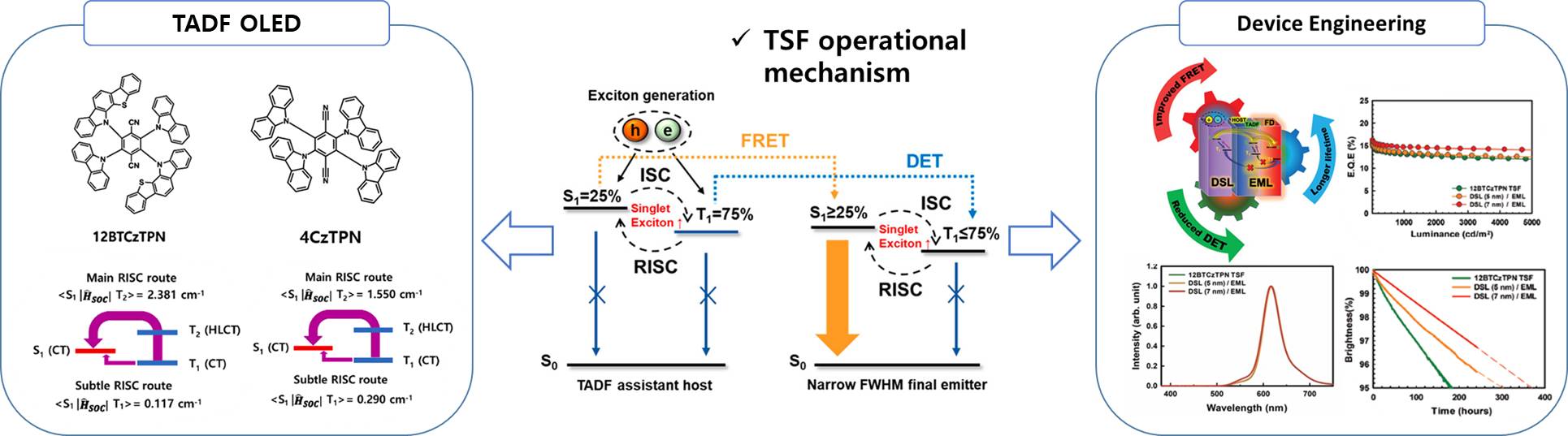
TADF OLED & TSF device system
Our laboratory focuses on the development of advanced TADF-sensitized fluorescence (TSF) technologies for high performance OLEDs. By combining TADF sensitizers with narrowband MR-TADF emitters, enabling fast energy transfer and rapid radiative decay, reducing exciton lifetimes and suppressing efficiency roll-off. To further improve the EQE and lifetime of OLED, our research focuses on novel TADF sensitizers, narrowband MR-TADF emitters, and innovative device architectures to enhance the color purity, efficiency and operational lifetime for next-generation display applications.
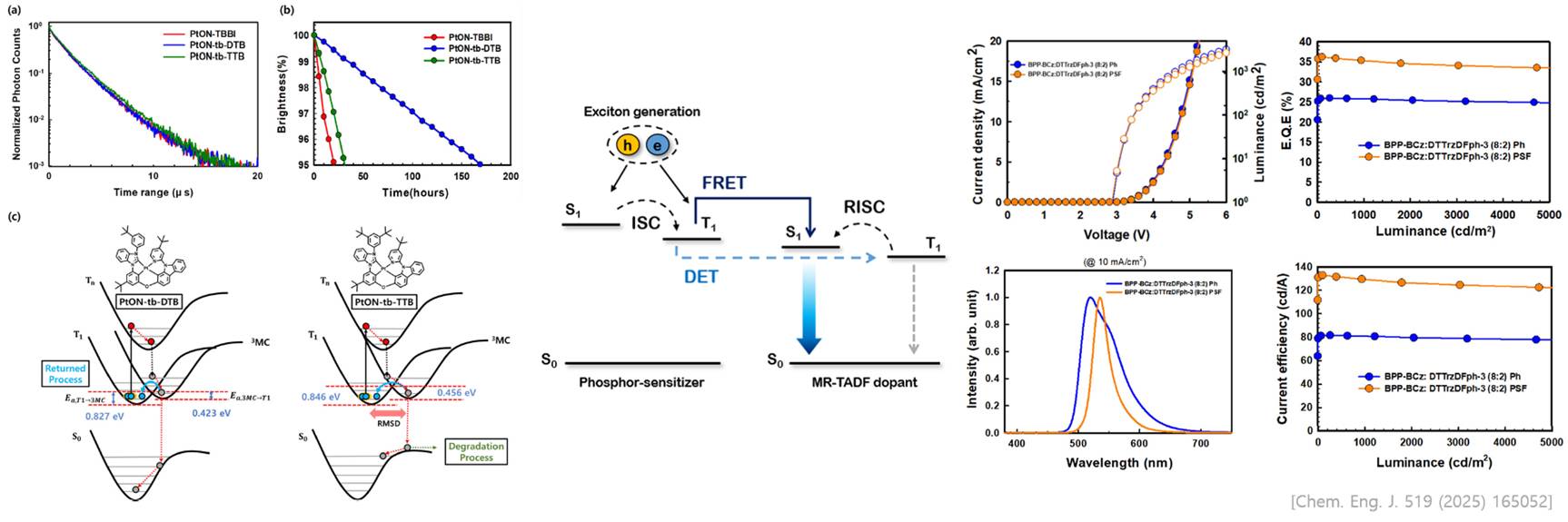
Phosphorescent and PSF OLED
To overcome the efficiency limitations of fluorescent devices and the stability/roll-off issues of MR-TADF emitters, our laboratory focuses on developing high-efficiency, long-lifetime phosphorescent OLEDs through device structure optimization and emission mechanism analysis. we are expanding our research to next-generation Phosphor-Sensitized Fluorescence (PSF) systems. By integrating the high efficiency of phosphors with the superior color purity of MR-TADF emitters, we aim to simultaneously surpass the current boundaries of efficiency and color gamut in display technology.
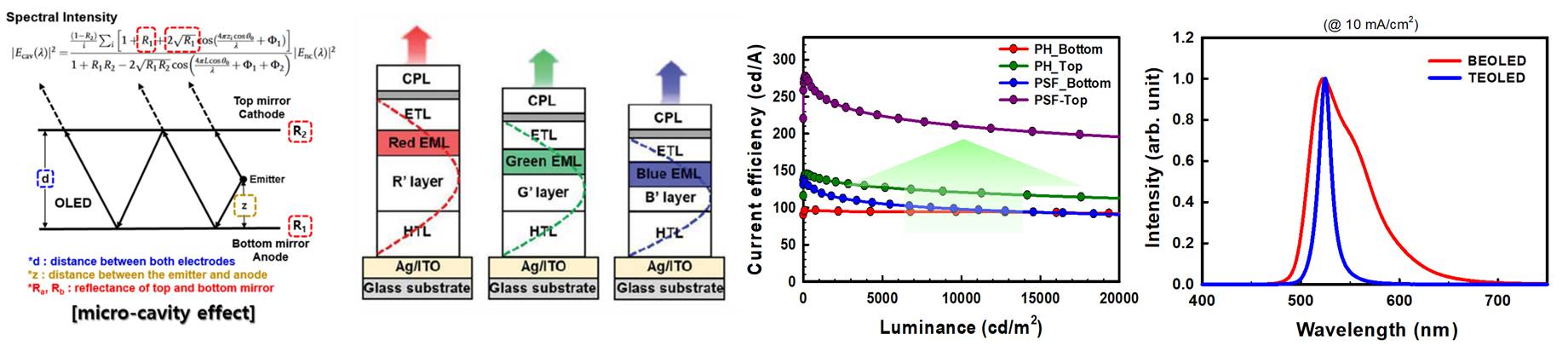
Top Emission OLED
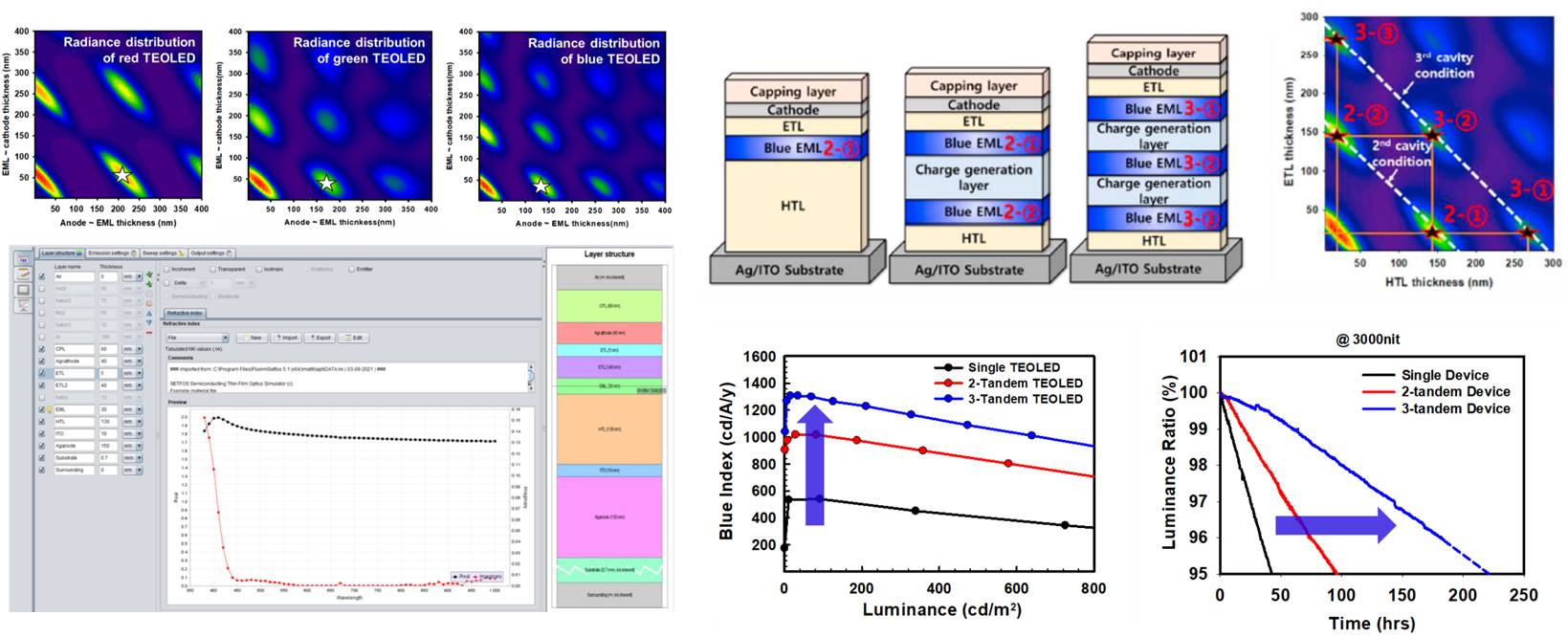
In practical OLED displays, Bottom Emission structures face significant challenges, such as reduced aperture ratios caused by the underlying TFT array. Consequently, research on Top Emission OLEDs (TE-OLEDs) has become indispensable. Our laboratory focuses on developing high-efficiency and high-color-purity devices by controlling the microcavity effect inherent in TE-OLED architectures. By precisely tuning emission wavelengths through microcavity control, we aim to realize next-generation display solutions with superior optical performance.
Tandem OLED
Our lab explores Tandem OLED technology to overcome the degradation issues of conventional single-unit devices. As the increased number of organic layers complicates the optical path, we employ sophisticated optical simulations to precisely predict and control the shifting cavity conditions. By stacking multiple organic layers, we aim to achieve high efficiency and extended operational lifetimes essential for next-generation applications. We specialize in the design of efficient Charge Generation Layers (CGL) and the optimization of multi-stack tandem structures to maximize overall device performance.
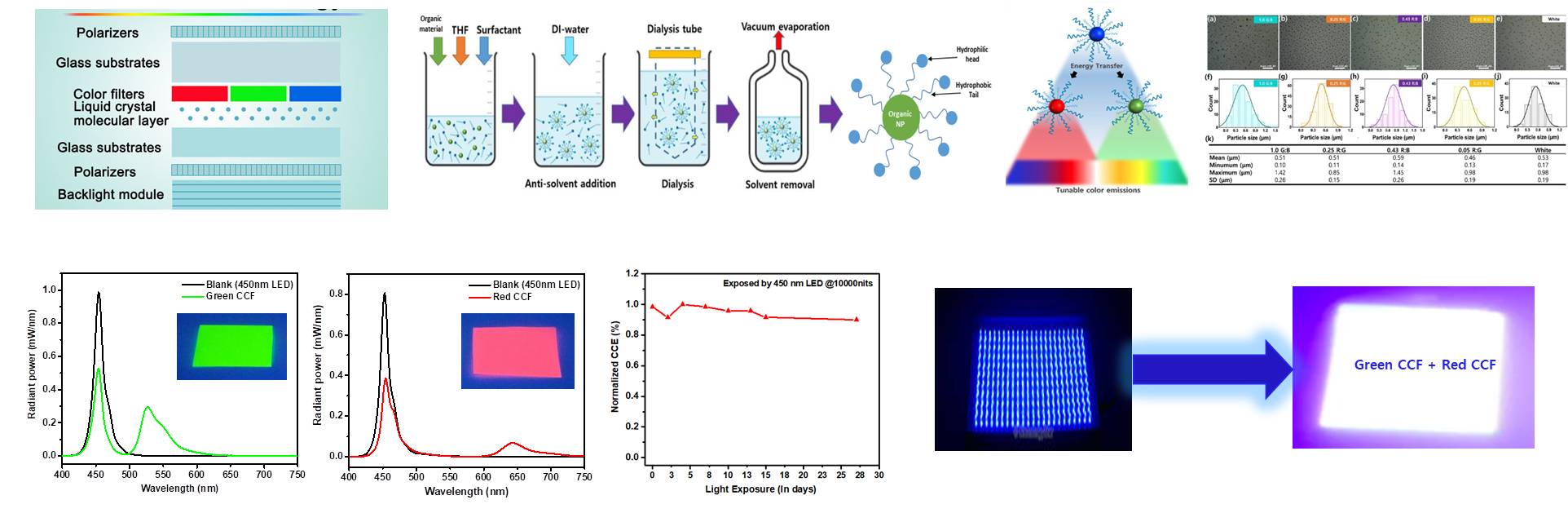
Nanodot
To overcome the thickness, reabsorption, and stability limitations associated with quantum dot (QD) based color conversion layers (CCLs), our laboratory focuses on the development of organic nanodot (OND) based color conversion materials for advanced display applications. Organic nanodots are nanoscale fluorescent materials composed of organic molecules, whose optical properties and solid-state stability can be effectively tuned through surfactant-assisted nanoscale organization. By leveraging their strong blue absorption, low self-absorption, and robust stability in thin films, we aim to realize low-loading CCLs with high efficiency and high operational stability. Through systematic material design and film architecture optimization, our research seeks to surpass the current limitations of QD systems and enable next-generation display technologies with improved color purity, efficiency, and durability.