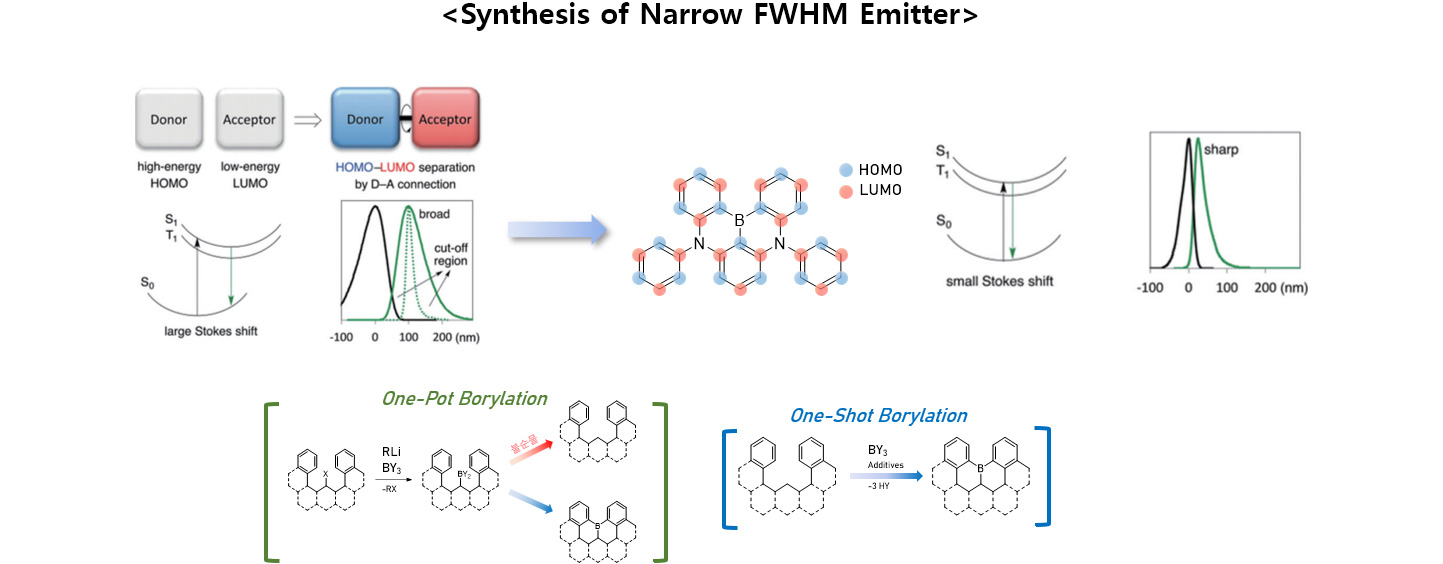
Synthesis of Narrow FWHM Emitter
To achieve superior color purity in OLED displays, our laboratory focuses on the synthesis of MR-TADF (Multi-Resonance Thermally Activated Delayed Fluorescence) emitters. These materials are designed using boron and nitrogen atoms to localize the HOMO and LUMO on specific regions of the molecule, enabling narrow emission bandwidths (small FWHM) and highly saturated colors. Through this molecular design strategy, we aim to synthesize emitters that satisfy the BT.2020 color coordinates across the RGB spectrum. To support practical device applications, we place strong emphasis on rational molecular design and the development of reliable synthetic routes that deliver high yields and reproducibility.
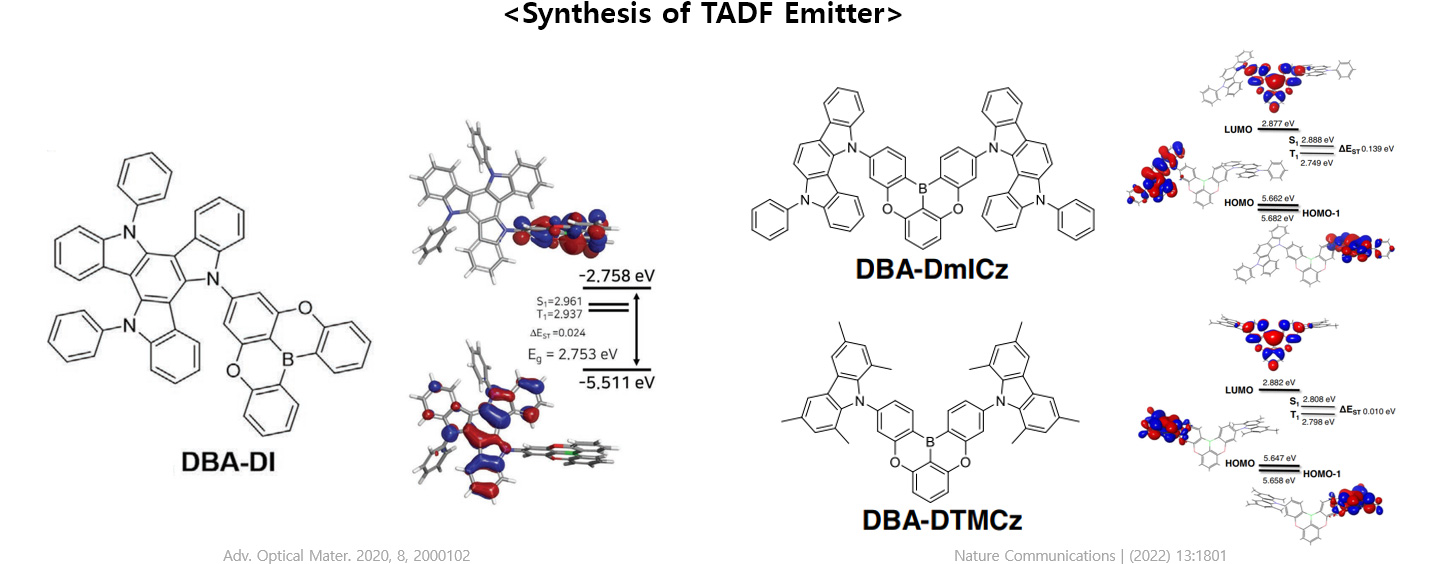
Synthesis of TADF Emitter
Our laboratory also develops TADF (Thermally Activated Delayed Fluorescence) emitters to achieve the theoretical limit of 100% internal quantum efficiency (IQE) in OLEDs. TADF materials harvest both singlet and triplet excitons by converting triplet excitons into emissive singlet states through the reverse intersystem crossing (RISC) process. To enable fast and efficient RISC, we design TADF molecules with a small singlet–triplet energy gap (ΔEST). This is achieved by spatially separating the HOMO and LUMO onto donor and acceptor units, respectively, which reduces exchange energy while maintaining effective radiative transitions. Through this molecular design strategy, we realize TADF emitters with rapid RISC, high exciton utilization, and excellent electroluminescent efficiency, making them strong candidates for high-performance OLED applications.
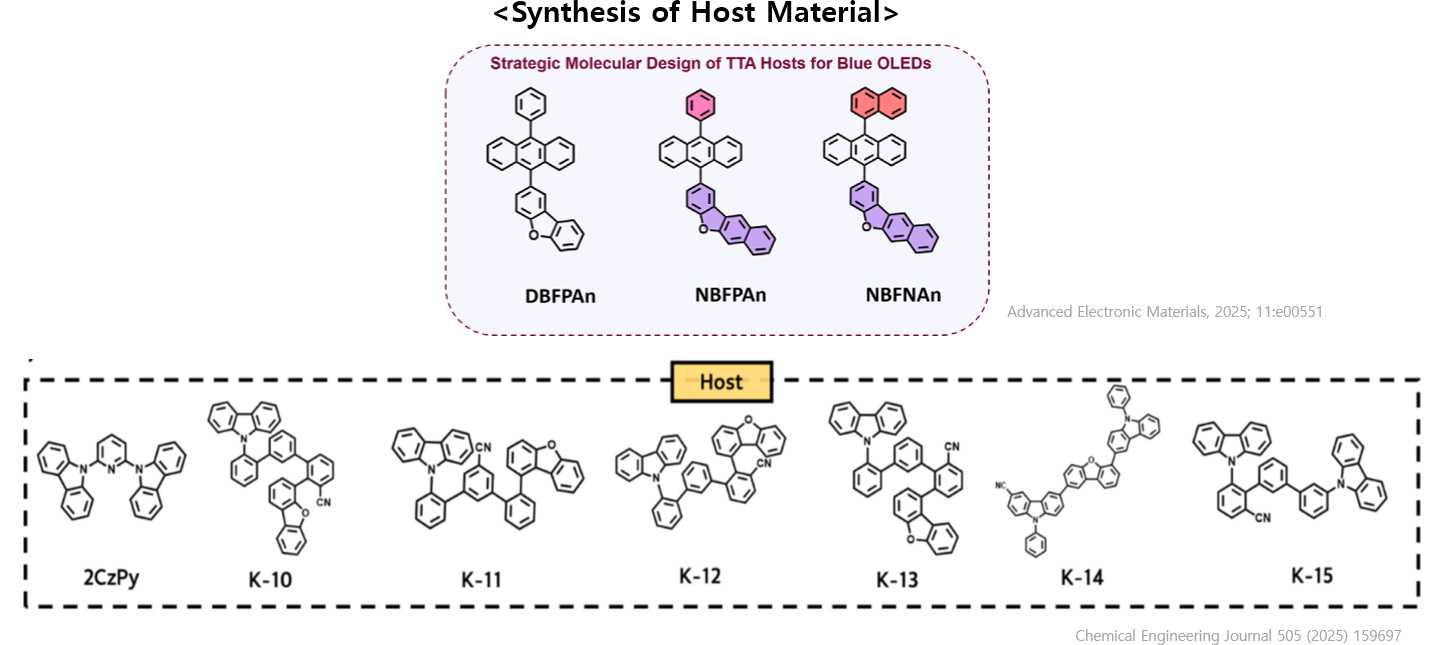
Synthesis of Host Material
The host material in an OLED plays a key role in supporting the emitter by transporting charge carriers and controlling exciton behavior in the emitting layer. A well-designed host must provide balanced hole and electron transport, confine excitons effectively, and maintain stability during device operation. Our laboratory develops high-performance OLED host materials based on experimental design and device optimization. By tuning molecular structures to achieve bipolar charge transport, we have realized host materials that significantly enhance device efficiency, enabling external quantum efficiencies above 30%. Through continuous material and device studies, we aim to establish reliable host platforms for next-generation OLED technologies.
Synthesis of Red MR-TADF
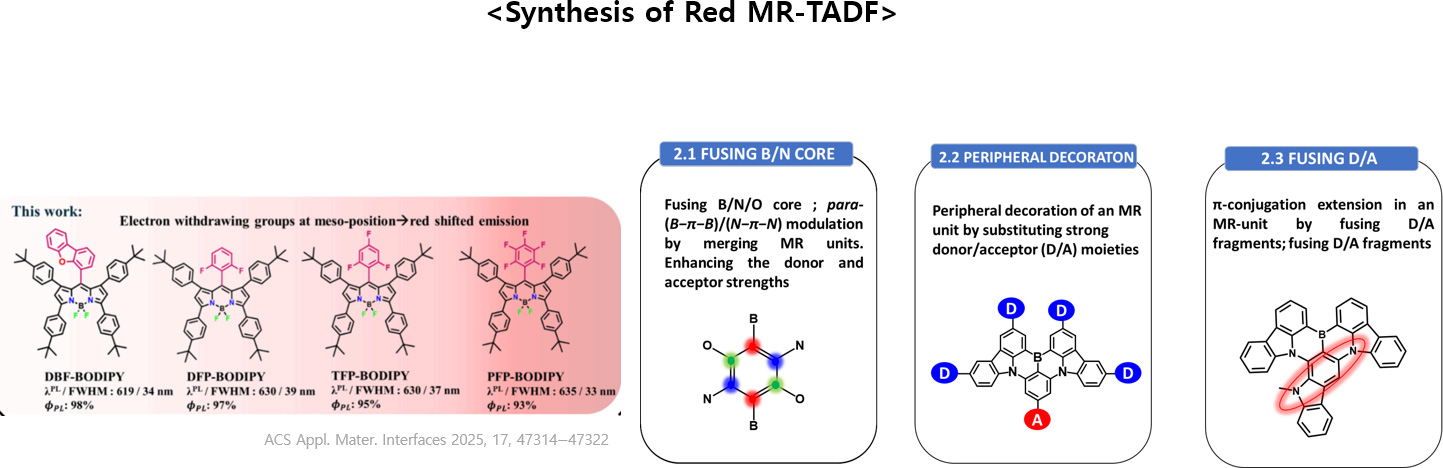
For red OLED emitters, our research includes the synthesis of materials based on BODIPY-type molecular structures, which enable emission wavelengths in the 620–630 nm range with high efficiency. While boron-containing architectures can also achieve red emission around 620 nm, they often suffer from lower efficiency and broader emission bandwidths. By contrast, the BODIPY framework effectively overcomes these limitations, providing improved efficiency and color purity. In parallel, we are actively exploring advanced boron-based molecular designs that target emission beyond 620 nm while maintaining narrow FWHM and high performance, expanding the design space for next-generation red OLED materials.
Synthesis of Green MR-TADF
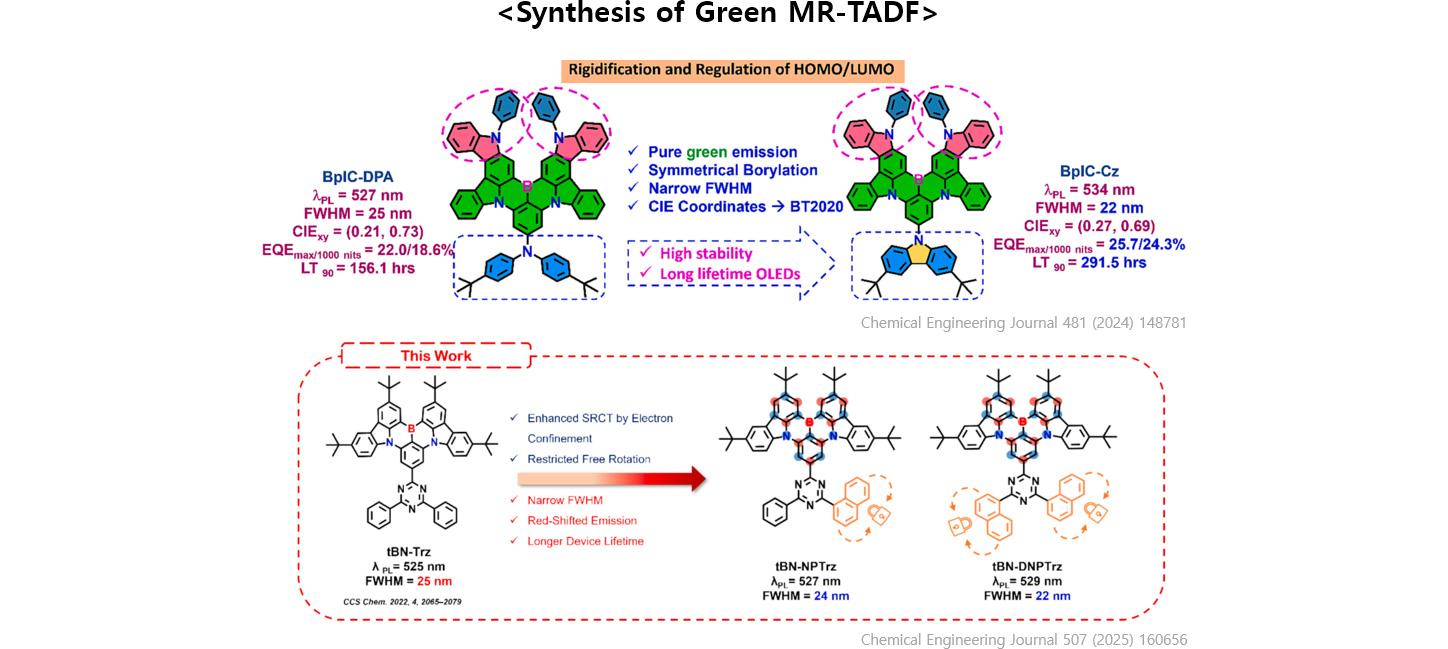
For high-quality green emission, achieving a narrow full width at half maximum (FWHM) is essential. Our approach relies on the design of rigid molecular frameworks, which effectively suppress vibrational coupling and minimize spectral broadening. By introducing various substituents, we fine-tune the HOMO and LUMO energy levels to precisely control the band gap, enabling emission at the desired green wavelengths. This systematic molecular engineering allows us to realize green emitters with high color purity, narrow emission spectra, and optimized optical performance.
Synthesis of Blue MR-TADF
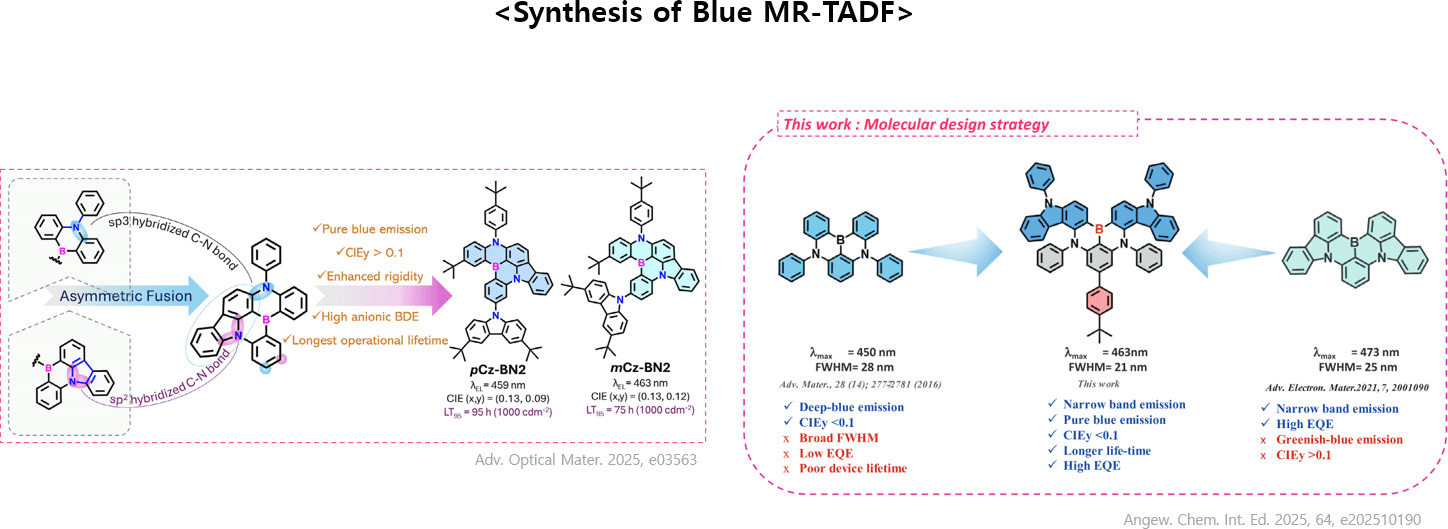
One of the key challenges in blue OLED materials is their short operational lifetime. To address this issue, we design blue emitters with a more rigid π-skeleton, which suppresses structural deformation during device operation. In addition, we stabilize the B–N and B–C bonding environments, leading to an increase in bond dissociation energy (BDE) and a reduction in chemical degradation rates. Through these strategies, we have successfully designed blue emitters that exhibit significantly improved stability and extended device lifetime, while maintaining high emission efficiency.